
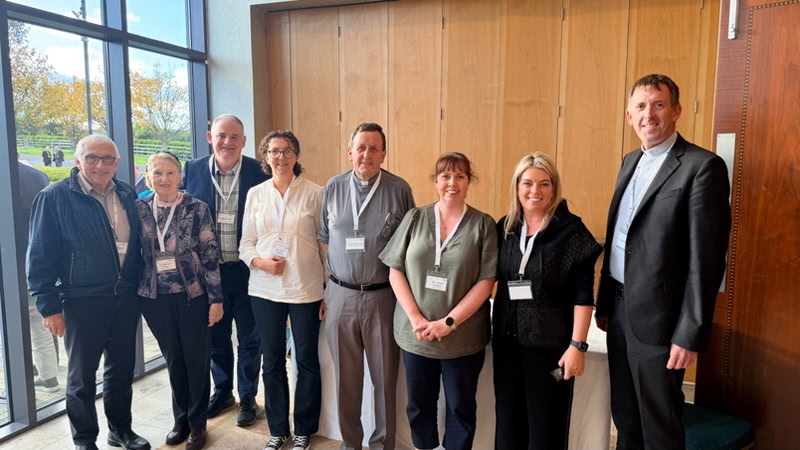
Delegates from the Dioceses of Ferns & Ossory
A Reflection by Delegate Sean O’Leary
At the National Synodal Assembly, something quiet happened at my table that stayed with me. A delegate asked to make a brief intervention to the whole assembly. Within moments, others around the table, people who did not share that view, were helping shape the wording so it would be clear and respectful. No one was trying to win an argument. They were making space for another voice to be heard.
Is that synodality in action? In a small but real way, yes. Synodality is not agreement. It is the habit of listening carefully enough that even those who disagree still help one another speak.
The recommendations emerging from the Assembly reveal both strong areas of agreement and some questions on which the more than 300 delegates, lay women and men, religious, priests and bishops, remained divided.
The strongest consensus centred on practical, mission-focused proposals: the development of the ministry of catechist, a continuing commitment to healing, parish communities as centres of faith formation, youth pilgrimages and gatherings, and the formation of all the baptised for co-responsible ministry. Strong support was also evident for youth leadership, adult faith formation, accompaniment, Catholic social teaching, and intentional pathways of discipleship.
A second group of proposals attracted substantial consensus, including outreach to those disconnected from the Church, support for family faith in the home, lay ministry, a ministry of listening and belonging, a national framework for co-responsibility, and pilot projects for new leadership models. Together these point towards a more participatory, missionary and locally engaged Church.
Moderate consensus emerged around language concerning LGBT+ people, marriage and family ministry, ecumenical dialogue, a commission for healing, and ensuring that women’s voices are more visible, heard and valued in liturgy and public prayer.
The voting on proposals concerning women revealed a nuanced picture. Delegates showed strong support for lay ministry, co-responsibility and greater visibility for women. What proved more contested were particular institutional responses, including a national office for women, a review of canon law in light of women’s baptismal mission, and advocacy for the continued exploration of women’s ministry, including the diaconate. Broad agreement on the importance of women’s contribution sat alongside less agreement on the structures through which that contribution might be advanced.
Most proposals received majority support, and many achieved substantial or strong consensus across a remarkably diverse body of delegates. Overall, delegates were most united around formation, accompaniment, youth engagement, healing, evangelisation and shared ministry. Greater divergence appeared when proposals touched on governance, new national structures, or the development of particular roles.
These recommendations have now been presented to the Irish Bishops’ Conference for further discernment. Yet the significance of the Assembly may not lie only in the percentages. Around tables throughout the day, people prayed together, listened carefully and enjoyed one another’s company. Those moments may prove just as important as any vote that was taken. They remind us that the synodal journey continues not only through decisions and recommendations, but through the patient practice of walking together.
For additional information please visit www.synod.ie